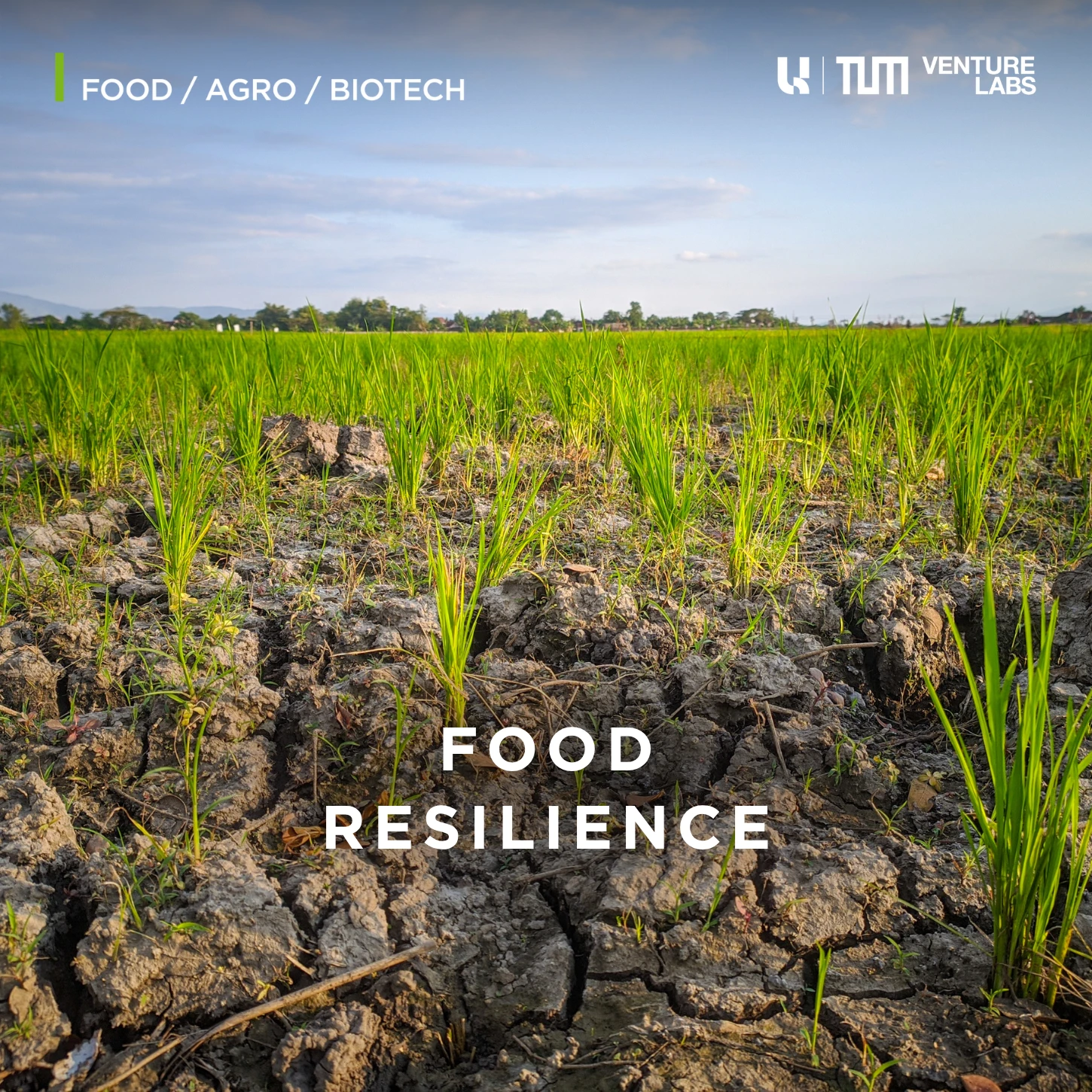
Food Resilience
Definition
Providing food is one of the most fundamental services of modern societies — and one of the most highly networked. In Europe, the basic supply of calories and proteins is largely secure. The real question is not whether enough is produced, but whether the system can withstand disruptions, adapt, and recover.
That capability is what food resilience describes. It differs from food security: food security is a state in which all people always have access to enough food. Resilience is the dynamic ability to maintain that state under stress. It rests on three components:
robustness — withstanding a disruption
adaptation — responding flexibly to it
recovery — returning to normal operations afterwards
Our focus covers the entire system: production, processing, transport, trade, sale, and consumption. Resilience is not a state one attains, but a capability that must be cultivated — and it arises not through isolation, but through the intelligent combination of a domestic base, diversified trade, buffers, and innovation.
Current Projects
AgriFood Demo Day 2026 & Symposium — "Feeding Europe: Where Innovation Meets Food Resilience"
September 17, 2026 | Pinakothek der Moderne, Munich | 9 am – 8 pm
The fifth AgriFood Demo Day brings together startups, investors, established companies, family businesses, and farmers around the innovations shaping the future of our food system. This year's focus includes New Ingredients, alongside bold pitches in AgriTech, FoodTech, and BioTech from teams out of the EIT Food Accelerator Network, XPRENEURS, TUM Venture Labs, UnternehmerTUM, and selected applicants.
The morning symposium works through resilience from three angles:
Industry: how can we future-proof the food chain?
Finance: where do investors see risk and opportunity in European food?
European food ecosystems: building the knowledge base for food security through research and innovation
All guests can also visit the Convivium exhibition "Nahrungssysteme am Limit" at the Architekturmuseum. The event is held in English and is funded by Landwirtschaftliche Rentenbank on behalf of the German Federal Ministry.
Position paper: "Germany's & Europe's Food Resilience"
The symposium is accompanied by our position paper on direct and indirect influencing factors, systemic linkages, and courses of action, written by Dr. Roman Bosl Werner.
Innovation Fields
controlled environment agriculture and protected cultivation decouple production from outdoor weather and enable year-round, water-saving production close to the point of consumption
expanding domestic protein sources addresses both the feed and the food side
combining fresh supply with closed nutrient loops
crop rotation, cover crops, and conservation tillage build soils that buffer drought and flooding, while strengthening biodiversity and carbon sequestration
recycled fertilisers with a lower fossil-energy footprint, anaerobic digestion for biogas and compost, and short local loops such as wastewater for irrigation
satellite-based monitoring as the data basis for early warning, harvest forecasts, and precise irrigation; with Copernicus and the Sentinel satellites, Europe has a sovereign base worth using consistently
natural gas is the material starting point of fertiliser production via the Haber-Bosch process; climate-neutral hydrogen is the route to breaking that coupling
nurseries, schools, canteens, hospitals, and care homes are the distribution infrastructure in an emergency. Five fields open up here: data-based demand forecasting, autonomous systems and robotics, adaptive food technologies, digital traceability and quality assurance, and energy-efficient kitchen infrastructure
the more that production, cold chains, and logistics are digitally networked, the more the protection of control systems becomes a resilience factor with immediate impact
Contact
Entire FAB Team